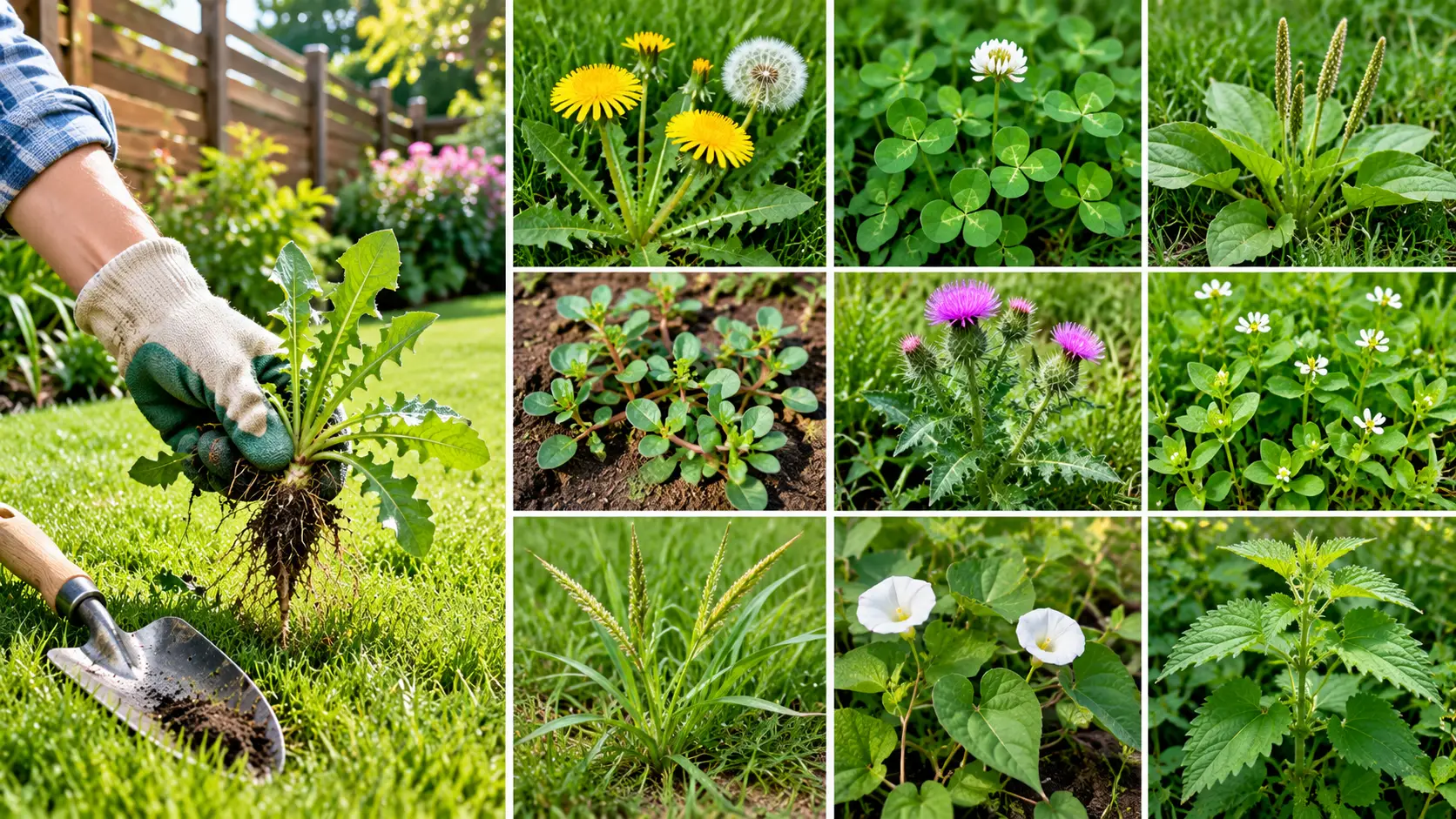
Weeds are among the most common challenges gardeners face when maintaining healthy lawns, flower beds, and vegetable gardens. These unwanted plants can spread quickly, compete with desirable plants for nutrients, and make outdoor spaces difficult to manage. Understanding the different types of weeds helps homeowners identify common species, recognize their growth patterns, and choose appropriate management methods.
Not every weed looks the same or behaves in a similar way. Some have broad leaves and colorful flowers, while others resemble ordinary grass or spread through underground roots. Learning how to identify weeds by their leaves, stems, roots, and growing habits can make garden maintenance easier and help prevent unwanted plants from taking over.
What Are Weeds and Why Do They Grow?
Weeds are plants growing in places where they are not wanted. A plant considered a weed in a vegetable garden might be useful in a wildflower meadow or natural habitat. The term describes how a plant affects a particular space rather than identifying one specific botanical family.
Many weeds grow successfully because they produce large numbers of seeds and adapt to different environmental conditions. Some thrive in compacted soil, while others prefer moist locations, disturbed ground, or sunny lawns. Their ability to establish quickly allows them to occupy spaces where desirable plants have not formed strong ground coverage.
Weeds may compete with garden plants for sunlight, water, nutrients, and growing space. However, certain species also provide food or shelter for insects and other wildlife. Understanding their ecological role helps gardeners decide which plants require removal and which can remain in less intensively maintained areas.
Main Categories of Weeds You Should Know
Weeds are commonly classified by their physical characteristics and life cycles. The three major appearance-based groups are broadleaf weeds, grassy weeds, and sedges. These categories help gardeners recognize differences in leaf shape, stem structure, and growth patterns before selecting suitable management practices.
Another useful classification separates weeds into annual, biennial, and perennial species. Annual weeds complete their life cycle in one growing season, while biennials generally take two growing seasons to mature and produce seeds. Perennials survive for multiple years and may return from established roots, crowns, bulbs, or underground stems.
Understanding both classifications makes weed identification more accurate. For example, crabgrass is typically an annual grassy weed, while dandelion is a perennial broadleaf weed. These distinctions matter because the most effective approach often depends on whether the plant spreads through seeds, persistent roots, or other reproductive structures.
Broadleaf Weeds: Identification and Common Examples
Broadleaf weeds usually have relatively wide leaves with branching or netlike veins. Many produce noticeable flowers, making them easier to distinguish from lawn grasses. Common examples include dandelions, white clover, plantain, chickweed, and several species of thistle found in gardens and landscaped areas.
<AsyncImageGroup query={[“common dandelion leaves and yellow flower garden close up”,”white clover trifoliate leaves white blossoms lawn”,”broadleaf plantain Plantago major ground rosette leaves”]} aspectRatio=”5:3″ layout=”carousel”/>
Dandelions develop recognizable yellow flower heads and deeply toothed leaves arranged in a low-growing rosette. White clover usually produces groups of three leaflets and small rounded flower heads. Broadleaf plantain has oval leaves with prominent veins extending from the base toward the tip, often growing close to the ground.
These plants differ significantly in how they spread and persist. Dandelions reproduce primarily through wind-dispersed seeds and regrow from established taproots, while white clover can also spread along creeping stems. Identifying the exact species helps gardeners choose practical control methods without unnecessarily disturbing surrounding vegetation.
Grassy Weeds: How to Recognize Them
Grassy weeds resemble desirable lawn grasses because they generally have narrow leaves with parallel veins and jointed stems. They can be difficult to identify when young, particularly when growing among turfgrass. Common examples include crabgrass, annual bluegrass, goosegrass, and certain unwanted foxtail grasses.
<AsyncImageGroup query={[“large crabgrass Digitaria sanguinalis spreading lawn close up”,”goosegrass Eleusine indica flat rosette on ground”,”annual bluegrass Poa annua seed heads lawn grass closeup”]} aspectRatio=”5:3″ layout=”carousel”/>
Crabgrass commonly develops a spreading growth habit, with stems radiating outward from a central point. Goosegrass also forms low-growing clusters, often with a flattened, pale center. Annual bluegrass frequently produces small, light-colored seed heads even when the surrounding lawn is regularly maintained.
Grassy weeds can establish where turf is thin, damaged, or poorly adapted to local growing conditions. Some tolerate compacted soil and heavy foot traffic better than desirable lawn varieties. Maintaining suitable mowing practices, adequate soil conditions, and healthy grass coverage can help reduce opportunities for these weeds to establish.
Sedge Weeds: What Makes Them Different?
Sedges are grasslike plants that belong to a different botanical family from true grasses. Many have triangular stems and leaves arranged in three directions, although identification requires checking several characteristics. Common lawn and garden examples include yellow nutsedge and purple nutsedge, which can become persistent in suitable environments.
<AsyncImageGroup query={[“yellow nutsedge Cyperus esculentus triangular stem leaves”,”purple nutsedge Cyperus rotundus flowering seed head”,”nutsedge growing taller than surrounding lawn grass”]} aspectRatio=”5:3″ layout=”carousel”/>
Yellow nutsedge usually has bright green leaves and can grow taller than surrounding turfgrass. Purple nutsedge commonly has narrower, darker green leaves and may produce reddish-purple flowering structures. Both species can develop underground tubers that allow plants to survive and spread even when visible shoots are removed.
These weeds often appear in lawns, garden beds, and areas with disturbed or poorly managed soil conditions. Some sedges tolerate moist soil, although different species have different environmental preferences. Successful management requires recognizing their underground growth structures rather than treating them exactly like ordinary grassy weeds.
Annual Weeds: Plants That Complete Their Life Cycle Quickly
Annual weeds grow from seed, mature, reproduce, and complete their life cycle within one growing season. Their rapid development allows them to establish in newly disturbed soil and open garden spaces. Examples include common chickweed, crabgrass, purslane, and lamb’s quarters, depending on local climate conditions.
Summer annual weeds generally germinate when soil temperatures rise and growing conditions become favorable. Crabgrass and common purslane are familiar examples that can spread through exposed soil or thin lawns. These plants often produce substantial numbers of seeds before dying when environmental conditions become unsuitable.
Winter annual weeds usually germinate during cooler periods, survive through part of winter, and produce seeds before warmer weather arrives. Common chickweed and annual bluegrass frequently follow this pattern in temperate regions. Preventing successful seed production is an important part of reducing future annual weed populations.
Biennial Weeds: Plants With a Two-Year Life Cycle
Biennial weeds generally complete their growth and reproduction over two growing seasons. During the first season, they often develop leaves and store energy in their roots. In the following season, they produce flowering stems, develop seeds, and usually die after completing reproduction.
Common examples include certain thistles, common mullein, and wild carrot in regions where these species grow as biennials. First-year plants may remain close to the ground, forming leafy rosettes that are easy to overlook. Their appearance can change dramatically when tall flowering stalks develop during the second growing season.
Identifying biennial weeds before flowering can make management more practical. Young rosettes are often easier to remove than mature plants with extensive root systems and developed seed heads. Gardeners should also recognize that some species may behave as annuals or short-lived perennials under different environmental conditions.
Perennial Weeds: Why They Keep Returning
Perennial weeds survive for more than two years and may reappear repeatedly from established underground structures. Unlike annual weeds, they do not necessarily depend on new seeds to return each season. Their persistence can make them particularly challenging in established lawns, vegetable gardens, and landscaped beds.
Common examples include dandelions, field bindweed, Canada thistle, and quackgrass. Some develop deep roots, while others spread through rhizomes or creeping underground stems. Even when aboveground growth disappears during cold or dry periods, surviving structures may produce new shoots when conditions improve.
Managing perennial weeds usually requires consistent attention over time rather than relying on a single removal session. Repeatedly removing young growth can gradually weaken some species, while careful root removal may work for isolated plants. Understanding how each weed stores energy and reproduces helps determine which management approach is most appropriate.
Creeping Weeds That Spread Across Lawns and Gardens
Creeping weeds grow horizontally across the ground and can gradually occupy large areas of lawns or garden beds. Some spread through aboveground runners called stolons, while others develop underground rhizomes. This growth pattern allows individual plants to establish new shoots beyond their original location and compete with surrounding vegetation.
<AsyncImageGroup query={[“ground ivy Glechoma hederacea creeping scalloped leaves purple flowers”,”creeping charlie weed spreading across green lawn”,”field bindweed Convolvulus arvensis white trumpet flower climbing garden”]} aspectRatio=”5:3″ layout=”carousel”/>
Ground ivy, also called creeping Charlie, is a familiar example with rounded, scalloped leaves and small purple flowers. Field bindweed produces slender climbing or trailing stems and trumpet-shaped flowers that are commonly white or pale pink. Both can spread through established vegetation, although they belong to different plant families.
Creeping weeds are often difficult to manage when their stems become intertwined with desirable plants. Removing visible shoots may not eliminate underground structures or rooted stem sections. Regular inspection, careful removal, and maintaining healthy ground coverage can help reduce their spread without unnecessarily damaging surrounding garden plants.
Common Flowering Weeds and Their Identification Features
Many flowering weeds are easily recognized by their colorful blooms, distinctive leaves, or unusual growth habits. Some produce small flowers that appear harmless, while others grow into large plants that compete with garden vegetation. Common examples include dandelions, creeping buttercups, henbit, and purple deadnettle.
<AsyncImageGroup query={[“purple deadnettle Lamium purpureum purple flowering weed close up”,”creeping buttercup Ranunculus repens yellow glossy flower”,”henbit Lamium amplexicaule pink purple flowers garden”]} aspectRatio=”5:3″ layout=”carousel”/>
Creeping buttercup has glossy yellow flowers and deeply divided leaves, often spreading through runners. Purple deadnettle develops small pink-purple flowers and triangular leaves that may appear reddish near the top. Henbit produces tubular purple flowers and rounded leaves that partially surround its stems.
Flower color alone is not enough to identify a weed accurately because unrelated species may look similar. Leaf arrangement, stem shape, plant height, and growth pattern provide additional clues. Taking clear photographs of these features and comparing them with reliable regional identification guides can help gardeners distinguish similar-looking plants.
Common Weeds Found in Vegetable Gardens
Vegetable gardens often provide favorable conditions for weeds because the soil is regularly disturbed, watered, and enriched with nutrients. These conditions encourage both vegetables and unwanted plants to grow quickly. Common garden weeds include purslane, lamb’s quarters, pigweed, chickweed, and various grasses.
Purslane develops thick, fleshy leaves and reddish stems that spread close to the ground. Lamb’s quarters often has triangular or diamond-shaped leaves with a pale, powdery appearance on younger growth. Pigweeds belong to the amaranth group and can become tall, fast-growing plants that produce substantial numbers of seeds.
Weeds may compete with young vegetables for moisture, nutrients, and growing space, particularly during early development. Shallow cultivation, hand removal, and suitable organic mulches can reduce competition in many gardens. Care should be taken around vegetable roots, and gardeners should accurately identify plants before considering any edible or medicinal uses.
How to Identify Weeds by Their Leaves, Stems, and Roots
Accurate weed identification begins with observing the plant’s overall growth habit and leaf characteristics. Broad leaves, narrow blades, serrated edges, and distinctive vein patterns can provide useful clues. The arrangement of leaves along a stem also helps distinguish species that otherwise appear similar.
Stem features offer another important identification method, especially when comparing grasses and sedges. Some plants have rounded stems, while others feature square or triangular shapes. Hairiness, branching patterns, and the presence of creeping runners can also help narrow down possible species.
Root structure can reveal whether a weed is likely to return after removal. Taproots grow downward from a central root, while fibrous systems contain many smaller roots spreading through the soil. Rhizomes, bulbs, and tubers are additional underground structures that can support regrowth, making careful identification valuable for long-term control.
Why Certain Types of Weeds Grow in Your Lawn
Weed populations can provide clues about growing conditions within a lawn or garden. Thin grass coverage, bare soil, repeated disturbance, and unsuitable maintenance practices may allow unwanted plants to establish. However, the presence of one weed species does not always prove that a particular soil problem exists.
For example, goosegrass commonly tolerates compacted environments, while some sedges grow successfully in areas with excess moisture. White clover can thrive in lawns with relatively low available nitrogen, although it also grows under other conditions. These associations can help guide further investigation rather than serving as definitive soil diagnoses.
Improving lawn health often reduces the available space for weeds to germinate and spread. Appropriate mowing heights, suitable watering, soil management, and overseeding with locally adapted grasses can strengthen desirable turf. Correcting underlying maintenance problems is usually more sustainable than repeatedly removing weeds without understanding why they return.
Natural and Practical Methods for Controlling Weeds
Hand pulling is a practical option for removing small weed populations, especially when the soil is slightly moist. Removing the root system can reduce regrowth for certain species, although persistent perennials may require repeated attention. Working carefully also helps protect the roots of nearby flowers, vegetables, and desirable lawn plants.
Mulching is another useful approach for managing weeds in garden beds and around established plants. Suitable organic materials help reduce light reaching the soil surface, making conditions less favorable for many germinating weed seeds. Mulch should be applied at an appropriate depth without burying plant crowns or pressing tightly against tree trunks.
Regular garden maintenance can also reduce the need for extensive weed removal. Removing unwanted plants before they produce seeds helps prevent new infestations, while maintaining healthy plant coverage reduces open growing space. Chemical herbicides, when considered, should only be selected for approved uses and applied strictly according to product labels and local requirements.
How to Prevent Weeds From Growing Back
Preventing weed regrowth requires understanding how unwanted plants reproduce and spread. Annual species often return from seeds already present in the soil, while perennials may regenerate from surviving underground structures. Because these processes differ, prevention methods should reflect the biology of the weeds being managed.
Healthy soil management and appropriate planting density can help desirable vegetation compete more effectively. In lawns, selecting suitable grass varieties and maintaining consistent mowing practices can reduce bare patches. Garden beds benefit from mulch, timely removal of emerging seedlings, and careful management of disturbed soil.
Long-term weed prevention is usually more effective when treated as part of routine garden care. Regular inspections help identify small problems before they expand into established infestations. Combining early identification, appropriate removal, and improved growing conditions can reduce recurring weeds without relying on one universal treatment.
Conclusion
Understanding the different types of weeds makes it easier to maintain healthy lawns, flower beds, and vegetable gardens. Broadleaf weeds, grassy weeds, and sedges have distinctive characteristics that help with identification. Recognizing whether a plant is annual, biennial, or perennial also provides useful information about its growth and reproduction.
Common examples such as dandelions, crabgrass, white clover, nutsedge, and field bindweed demonstrate how much weeds can vary in appearance and behavior. Some spread primarily through seeds, while others return from persistent underground structures. Accurate identification helps gardeners select suitable management methods and avoid unnecessary damage to desirable vegetation.
Effective weed management combines regular observation, healthy planting conditions, and appropriate control techniques. Removing weeds early, maintaining good ground coverage, and understanding local growing conditions can reduce recurring problems. With consistent care, gardeners can maintain attractive outdoor spaces while making informed decisions about unwanted plants.
Frequently Asked Questions (FAQs)
What Are the Three Main Types of Weeds?
The three major appearance-based categories are broadleaf weeds, grassy weeds, and sedges. They differ in leaf structure, stem characteristics, and growth patterns, helping gardeners identify unwanted plants and select appropriate control methods.
What Are the Most Common Weeds Found in Lawns?
Common lawn weeds include dandelions, white clover, crabgrass, annual bluegrass, plantain, and nutsedge. The species present depend on local climate, grass varieties, soil conditions, and lawn maintenance practices.
How Can I Identify an Unknown Weed?
Examine the plant’s leaves, stem shape, flowers, roots, and overall growth habit. Compare these characteristics with a reliable regional plant identification guide before choosing a removal or management method.
What Is the Difference Between Annual and Perennial Weeds?
Annual weeds complete their life cycle within one growing season and reproduce through seeds. Perennial weeds survive for multiple years and may return from established roots, rhizomes, tubers, or other underground structures.
What Is the Best Way to Prevent Weeds Naturally?
Maintaining healthy plant coverage, applying suitable mulch, and removing weeds before seed production can reduce infestations. Regular garden inspections and improving growing conditions also support long-term weed prevention.